

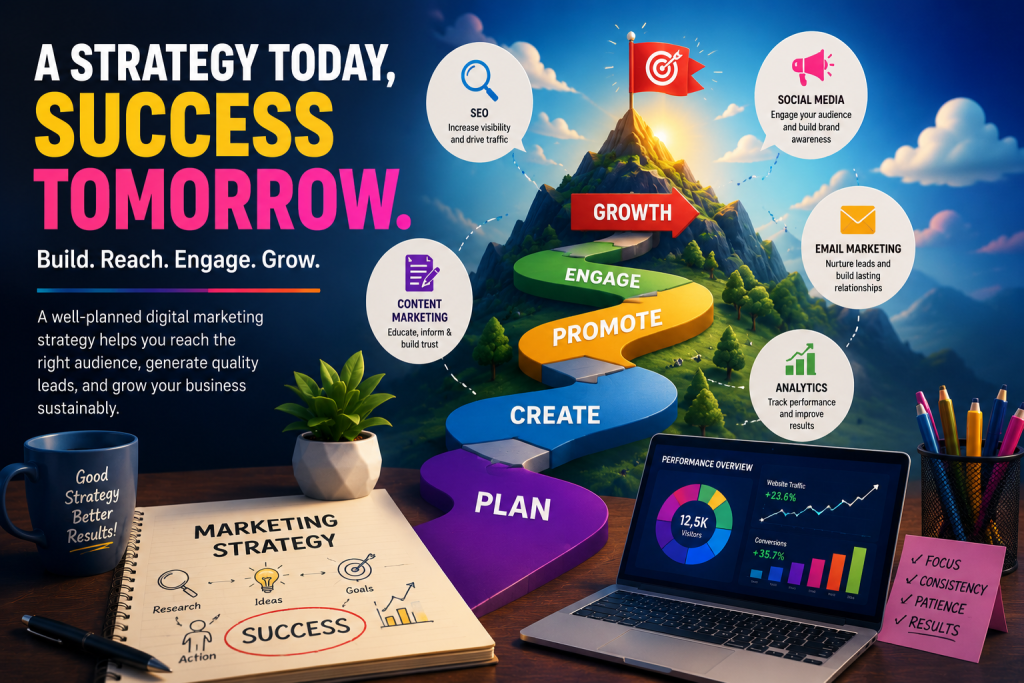
Every successful business has one thing in common—they don’t market by chance; instead, they succeed with a Digital Marketing Strategy in 2026 that is built for long-term growth, stronger brand visibility, and measurable results.
Think about the last time you searched for a product or service online. You probably typed your query into Google, browsed a few websites, checked customer reviews, visited social media pages, and only then decided whom to trust. Today, this has become the standard buying journey for customers.
Now, imagine your business isn’t visible during that journey. Your competitors are appearing in search results, running targeted advertisements, engaging audiences on social media, and publishing valuable content, while your business remains difficult to find. As a result, every day without a clear digital marketing strategy is a missed opportunity to attract new customers and grow your brand.
However, many businesses believe that posting occasionally on social media or running a few Google Ads is enough. In reality, these are only individual tactics. What truly drives long-term success is a comprehensive digital marketing strategy that brings every marketing channel together with one clear objective—helping your business grow.
Whether you’re a startup, a local business, or an established company looking to scale, having a well-planned digital marketing strategy allows you to reach the right audience, build trust, generate qualified leads, and increase sales consistently.
Finally, in this guide, we’ll explore what a digital marketing strategy is, why it’s essential, the key components of a successful plan, common mistakes to avoid, and how your business can stay ahead in an increasingly competitive digital landscape.
Table of Contents
| Section | What You’ll Learn |
| What Is a Digital Marketing Strategy? | Understanding the foundation |
| Why Every Business Needs One | Business benefits and growth opportunities |
| Essential Components | Building blocks of success |
| How to Build a Winning Strategy | Step-by-step planning process |
| Common Mistakes | Marketing pitfalls to avoid |
| DIY vs Hiring an Agency | Which approach works best? |
| Measuring Success | Important marketing metrics |
| Final Thoughts | Key takeaways |
What Is a Digital Marketing Strategy in 2026?
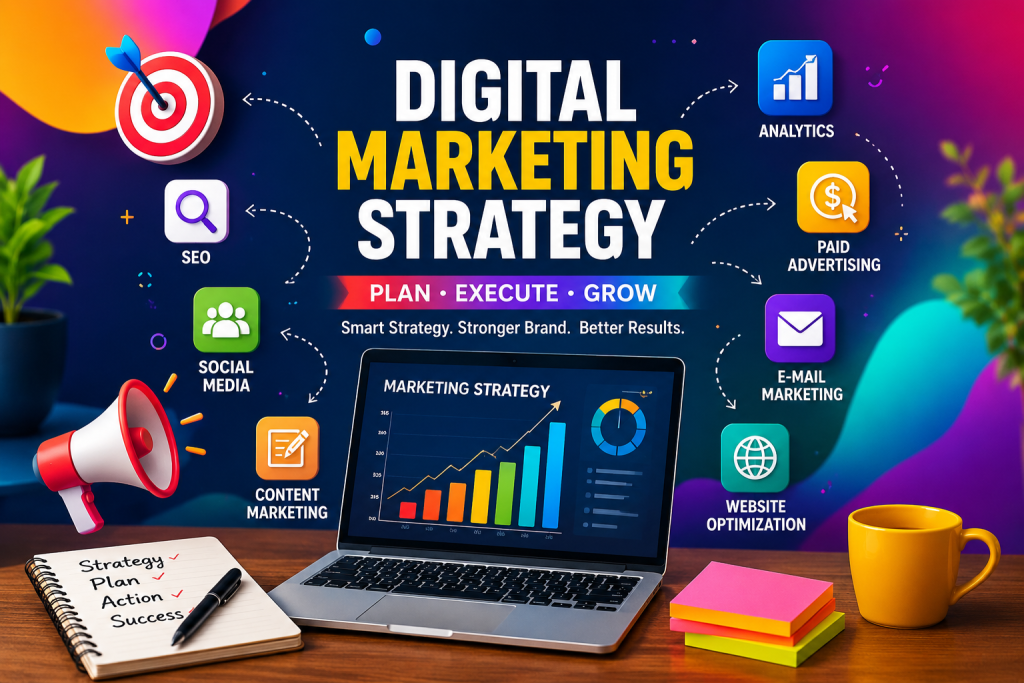
A Digital Marketing Strategy in 2026 is a structured plan that outlines how a business uses online marketing channels to achieve specific goals. Instead of relying on random marketing activities, a Digital Marketing Strategy in 2026 provides a clear roadmap, ensuring every campaign supports measurable business growth, increases brand visibility, and delivers long-term success.
Moreover, rather than focusing on a single platform, an effective strategy combines multiple digital channels that work together throughout the customer’s buying journey.
These channels may include:
- Search Engine Optimization (SEO)
- Google Ads (PPC)
- Social Media Marketing
- Content Marketing
- Email Marketing
- Website Optimization
- Local SEO
- Conversion Rate Optimization (CRO)
- Analytics and Performance Tracking
Ultimately, when these channels are aligned, they create a seamless experience that attracts visitors, builds trust, and converts them into loyal customers.
Why Every Business Needs a Strong Digital Marketing Strategy in 2026
The digital marketplace is becoming more competitive every year. Customers have countless options, and businesses must work harder to capture attention.
Without a strategy, marketing efforts often become inconsistent, expensive, and ineffective.
Here’s why every business should invest in a digital marketing strategy.
1. It Helps You Reach the Right Audience
Marketing isn’t about reaching everyone.
It’s about reaching the people who are most likely to become customers.
A strong strategy identifies your ideal audience based on demographics, interests, search behavior, online habits, and purchasing intent. This allows your campaigns to deliver the right message to the right people at the right time.
2. It Maximizes Your Marketing Budget
Many businesses waste money because they invest in channels without understanding which ones generate results.
Therefore, a strategic marketing plan ensures your budget is spent wisely by focusing on platforms and campaigns that deliver measurable returns.
Instead of guessing what works, every decision is backed by data.
3. It Builds Brand Awareness
People buy from brands they recognize and trust.
Consistent messaging across your website, social media, search engines, and email campaigns strengthens your brand identity and keeps your business top of mind.
The more often potential customers encounter your brand, the more likely they are to remember you when they’re ready to buy.
4. It Generates Better Quality Leads
Not every website visitor becomes a customer.
A digital marketing strategy focuses on attracting qualified leads-people who are actively searching for your products or services.
Higher-quality leads usually result in higher conversion rates and better return on investment.
5. It Supports Long-Term Business Growth
In contrast, unlike short-term marketing tactics, a strategy creates sustainable growth.
SEO continues driving organic traffic.
Content continues attracting visitors.
Email campaigns nurture customer relationships.
Social media strengthens community engagement.
Together, these efforts create a marketing system that delivers value long after individual campaigns have ended.
Essential Components of a Successful Digital Marketing Strategy in 2026
Every successful strategy is built on several key pillars.
Define Clear Business Goals
Every marketing activity should support a business objective.
Ask yourself:
- Do you want more website traffic?
- More enquiries?
- More online sales?
- Better brand recognition?
- More local customers?
Having clear goals helps measure progress and keeps your marketing efforts focused.
Understand Your Target Audience
One of the biggest marketing mistakes is assuming everyone is your customer.
Research your audience carefully.
Consider:
- Age
- Location
- Income
- Occupation
- Interests
- Pain points
- Buying habits
- Preferred online platforms
The better you understand your audience, the more relevant your marketing becomes.
Build a High-Performing Website
Your website is often the first impression customers have of your business.
An effective website should be:
| Essential Feature | Why It Matters |
| Mobile Responsive | Most users browse on smartphones |
| Fast Loading | Improves user experience and SEO |
| Easy Navigation | Helps visitors find information quickly |
| Secure (HTTPS) | Builds trust with users |
| Clear Call-to-Actions | Encourages enquiries and conversions |
| SEO Optimized | Helps rank higher on Google |
A Digital Marketing Strategy in 2026 is incomplete without a website that delivers excellent performance, usability, and a seamless user experience.
Invest in Search Engine Optimization (SEO)
SEO helps your business appear when customers search for products or services online.
Unlike paid advertising, SEO generates organic traffic that continues growing over time.
A successful SEO strategy includes:
- Keyword research
- Technical SEO
- On-page optimization
- Content creation
- Internal linking
- Quality backlinks
- Local SEO optimization
SEO requires patience, but the long-term benefits make it one of the most valuable digital marketing investments.
Use Paid Advertising Wisely
Google Ads and social media advertising provide immediate visibility.
Paid campaigns are particularly effective for:
- New product launches
- Seasonal promotions
- Local services
- Lead generation
- Brand awareness
- eCommerce sales
The most successful businesses combine paid advertising with long-term SEO rather than relying on only one channel.
Create High-Quality Content
Content is the foundation of digital marketing.
It educates customers, answers questions, builds trust, and improves search rankings.
Useful content includes:
- Blog articles
- Case studies
- Videos
- Infographics
- Guides
- FAQs
- Success stories
Instead of selling constantly, focus on solving customer problems.
Helpful businesses earn trust.
Trusted businesses earn customers.
Strengthen Your Social Media Presence with a Digital Marketing Strategy in 2026
Social media is more than posting attractive graphics.
It’s about creating conversations and relationships.
A consistent social media strategy helps businesses:
- Increase brand awareness
- Improve customer engagement
- Build trust
- Drive website traffic
- Generate enquiries
- Showcase company culture
The key is consistency rather than quantity.
Posting valuable content regularly is a key part of a successful Digital Marketing Strategy in 2026, delivering better results than posting every day without a clear purpose.
Don’t Ignore Email Marketing
Despite the rise of social media, email remains one of the highest-performing marketing channels.
Email marketing helps businesses:
- Nurture leads
- Promote new products
- Share company updates
- Increase repeat purchases
- Build customer loyalty
Personalized emails consistently outperform generic promotional messages.
How to Build a Winning Digital Marketing Strategy in 2026
A successful strategy doesn’t happen overnight.
It requires planning, testing, measuring, and continuous improvement.
| Step | Action |
| 1 | Define business goals |
| 2 | Research your audience |
| 3 | Analyze competitors |
| 4 | Perform keyword research |
| 5 | Optimize your website |
| 6 | Create valuable content |
| 7 | Launch SEO and advertising campaigns |
| 8 | Track performance |
| 9 | Improve continuously using data |
Marketing is an ongoing process, not a one-time project.
Businesses that regularly analyze and improve their strategy consistently outperform those that don’t.
Common Digital Marketing Strategy Mistakes to Avoid in 2026
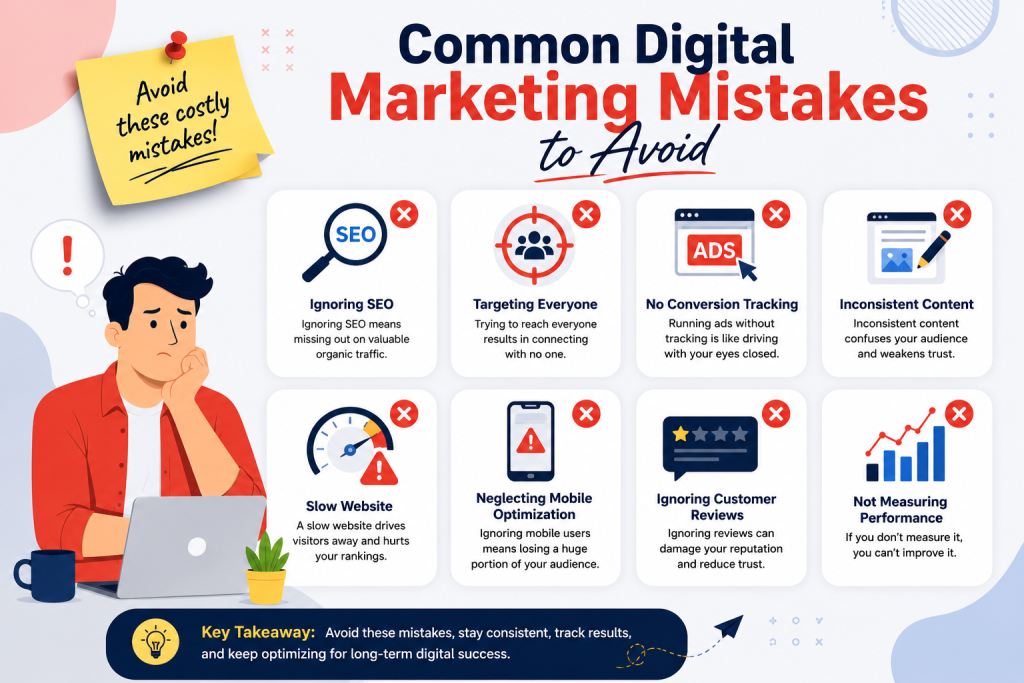
Even businesses with good intentions often make costly mistakes.
Some of the most common include:
- Ignoring SEO
- Targeting everyone instead of a specific audience
- Running ads without tracking conversions
- Publishing inconsistent content
- Having a slow website
- Neglecting mobile optimization
- Ignoring customer reviews
- Not measuring marketing performance
Therefore, avoiding these mistakes can save significant time and budget while improving overall results.
Digital Marketing Strategy in 2026: DIY Marketing vs Hiring an Agency
Often, many businesses wonder whether to manage digital marketing internally or work with an experienced agency.
Here’s a comparison:
| DIY Marketing | Digital Marketing Agency |
| Limited expertise | Experienced specialists |
| Time-consuming | Saves business owners valuable time |
| Limited software | Access to premium marketing tools |
| Trial and error | Proven strategies |
| Basic reporting | Advanced analytics and insights |
| Slower growth | Faster, data-driven improvements |
While small businesses may start with DIY marketing, partnering with an experienced agency often accelerates growth and provides access to expertise across multiple marketing disciplines.
Tracking the Performance of Your Digital Marketing Strategy in 2026
A digital marketing strategy should always be measurable.
Track key performance indicators (KPIs) such as:
- Website traffic
- Organic keyword rankings
- Conversion rate
- Lead generation
- Cost per lead
- Return on Investment (ROI)
- Click-through rate (CTR)
- Customer acquisition cost
- Email open rate
- Social media engagement
Regular reporting helps identify what’s working, what isn’t, and where new opportunities exist.
Remember, successful marketing isn’t about collecting data-it’s about using data to make smarter business decisions.
Final Thoughts
A successful business doesn’t rely on luck-it relies on strategy. In today’s competitive digital landscape, simply having a website or social media profile isn’t enough. Customers expect businesses to be visible, informative, trustworthy, and easy to connect with across multiple online channels.
Moreover, a well-planned digital marketing strategy brings together SEO, paid advertising, content marketing, social media, email marketing, and website optimization into one cohesive plan that supports your business goals. It helps you attract the right audience, build lasting relationships, generate qualified leads, and create sustainable growth.
Most importantly, a strategy gives you direction. Instead of reacting to trends or trying every new marketing tactic, you’ll have a clear roadmap that guides your decisions and ensures every marketing effort contributes to measurable results.
Whether you’re just starting your digital journey or looking to improve your current approach, investing in a strong digital marketing strategy is one of the smartest decisions you can make. Ultimately, the businesses that plan today are the ones that lead tomorrow. Therefore, start with a strategy, stay consistent, measure your progress, and continue refining your approach-because long-term success is built through continuous improvement, not one-time campaigns.
FAQs
What is a digital marketing strategy?
A digital marketing strategy is a structured plan that outlines how a business uses online channels such as SEO, social media, paid advertising, content marketing, email marketing, and website optimization to achieve its marketing and sales goals.
Why is a digital marketing strategy important for small businesses?
A digital marketing strategy helps small businesses compete with larger brands by improving online visibility, attracting qualified leads, increasing customer engagement, and maximizing marketing budgets.
How long does it take to see results from digital marketing?
The timeline depends on the marketing channel. Paid advertising can generate results almost immediately, while SEO and content marketing typically take several months to build sustainable organic traffic and long-term growth.
What’s the difference between a digital marketing strategy and a marketing campaign?
A digital marketing strategy is the long-term roadmap that defines your goals and overall approach. In contrast, a marketing campaign is a specific initiative, such as a seasonal promotion or product launch, that supports the broader strategy.
Should I focus on SEO or Google Ads?
Both have unique advantages. SEO builds long-term organic visibility and credibility, while Google Ads delivers immediate traffic and leads. For most businesses, combining both creates the strongest digital marketing strategy.